Safety from Showrooms to Soaks
Challenges and solutions for spa retailers
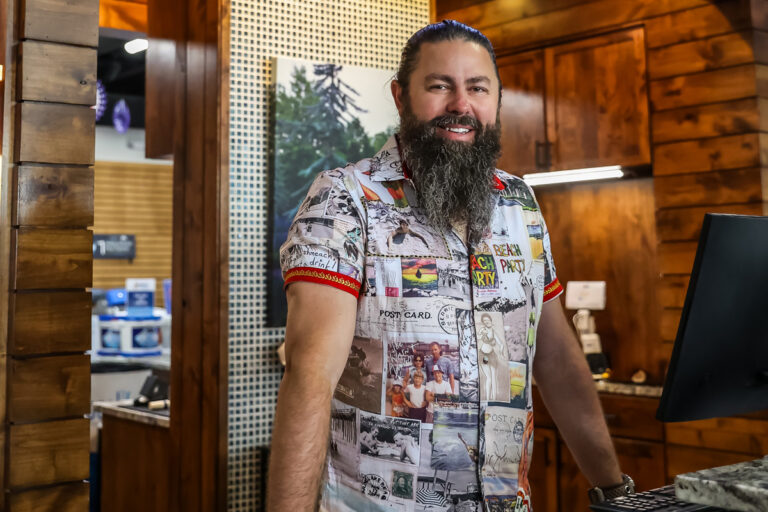
Whether it’s solving day-to-day problems or plotting long-term growth, spa retailers have a lot of priorities but chief among them is workplace safety. “This is a top-of-mind subject for us right now,” says Scott Clark, owner/operator of The Spa & Sauna Co., headquartered in Reno, Nevada.
The Occupational Safety and Health Administration, state and local safety requirements all factor into retailers’ best practices, which they incorporate into employee manuals and videos when onboarding.
“If we bump up against something that isn’t covered [in our procedure manuals], that is an orange flag that we need to get it written up,” says Sky Matula, president and CEO of The Hot Tub Store based in Santa Rosa, California. “We’re a specialty business; it’s not a cookie-cutter thing you can buy a procedures manual for.”
We’re a specialty business; it’s not a cookie-cutter thing you can buy a procedures manual for.” Sky Matula, The Hot Tub Store
Clark says some major manufacturers haven’t updated their best practices for material handling since before the pandemic, although their products have changed. So, they’ve had to determine how to safely handle those things on their own.
“Many manufacturers have updated their spa siding, corner radiuses and even the base pans under the spa,” he explains. “These changes often facilitate a need to change the process we use to down-stack the product from shipping pallets, remove from pallets for loading onto our vehicles and even how we perform final assembly and accessory installation in customer yards.”
Clark’s company has also “probably doubled the number of employees since 2019,” which has required uniform safety training across the brand’s locations in Nevada and California. “We’ve been working on it, but it is a challenge.”
Safety is a hot topic for the entire industry, so we asked several veteran spa retailers about their safety challenges and solutions, with some surprising situations they now face.
Showrooms: Keeping them safe
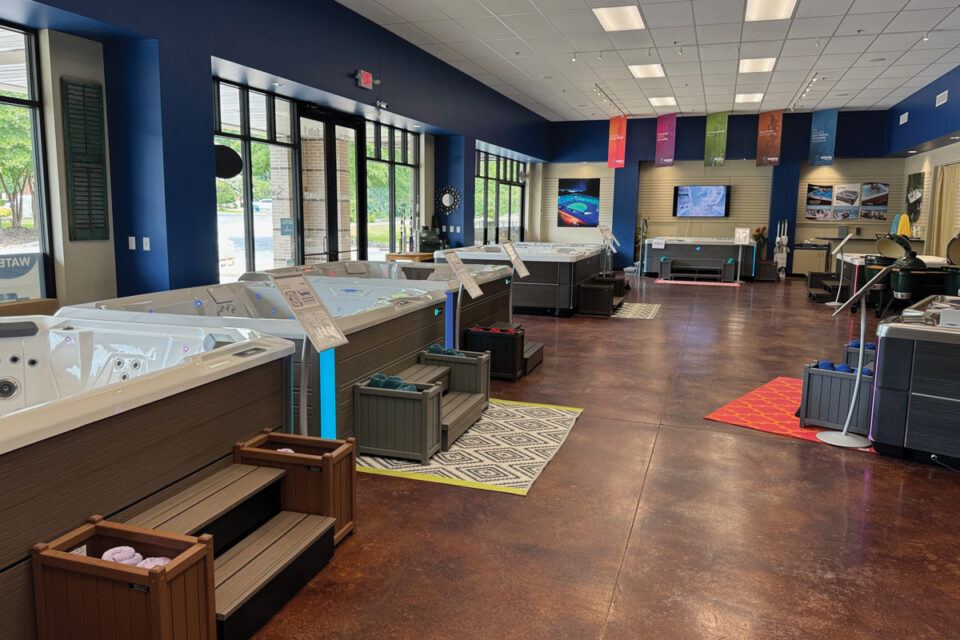
Spa retailer showrooms are considered a low hazard from an OSHA perspective, says Curtis Chambers, president of OSHA Training Services, a national company based in Arlington, Texas. Retailers already follow common fire department regulations involving exit doors, well-lighted exit signs, working fire extinguishers, fire alarms and sprinklers — items in their daily routine or maintenance schedule.
“We have two marked exit doors and part of our morning routine is to make sure those doors are unlocked and we have access to them,” says David Townley, president of Townley Pool & Spa in Little Rock, Arkansas. “There’s some safety lighting so, even in the middle of the night, you could still find the emergency exits.”
While Townley’s city fire department inspects his business twice a year, some retailers have had to become self-reliant out of necessity. Some local fire departments don’t have the budget to make routine on-site inspections, so Clark’s employees meticulously complete the department’s checklist, and he contracts with a fire extinguisher service company.
For spa retailers, keeping floors dry and clean is critical, particularly with the moisture generated by water-filled tubs or water splashed from a display model. Clark says they have “Wet Floor” signs and the ubiquitous yellow mop buckets at the ready.
Chambers notes that retailers should have a written emergency action plan covering situations like fires or chemical spills. Keeping employees safe from unpleasant or even dangerous customers is another. “Our employees have permission to get people out of the store and lock the door or call the police, if necessary,” Matula says.
It’s important to remember that OSHA requires a written hazard communication program for retailers that deal with the storage and handling of chemicals, Chambers says. They also need to have Safety Data Sheets for all chemicals or hazardous materials; these include detailed information on composition, fire-fighting measures, first aid, accidental release and more.
Townley says one tactic to minimize risk is to have as few chemicals as possible on display in the showroom. “First, you don’t want customers to walk in and the showroom smells like chemicals, or you imply you need a lot of chemicals to maintain your spa.” Also, he says, they’re easier to manage in the warehouse.
Warehouse maneuvering and storage
Safety concerns usually emerge during the movement of tubs from manufacturer delivery to their placement in storage. Matula’s new warehouse in Sacramento has a loading dock where employees can drive the forklift right onto the truck, pull the pallet and drive onto the warehouse floor. His other warehouse does not, which is common for most retailers and requires an involved process that is inefficient but necessary.
Forklift drivers moving pallets need to maneuver around narrow doors and posts or other stationary structures in most warehouses. The equipment itself must be maintained on a schedule, Clark says; drivers need to be certified and use spotters where necessary to stack and down-stack safely. Chambers adds that the metal storage racks must also be secured to the floor and the walls.
Customer delivery and installation
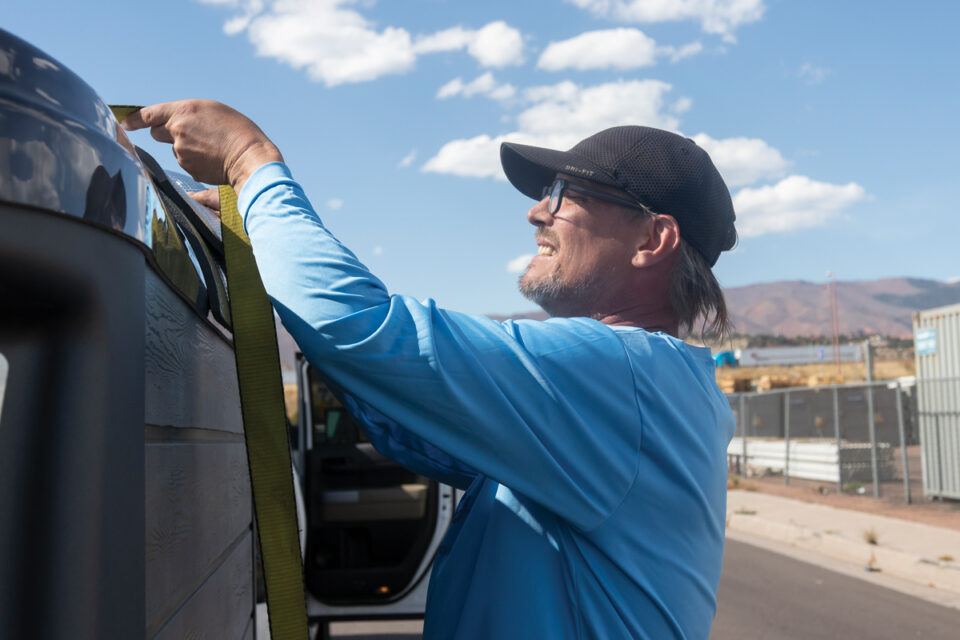
Safety precautions are essential during both delivery and installation. Townley goes beyond standard GPS tracking of delivery trucks by also monitoring the driver’s speed and instances of harsh braking. The payoff, besides keeping everyone safe, is an insurance discount based on the company’s driving record, he says.
Townley explains that his company has Spa Dolly trailers that are designed specifically to deliver hot tubs. During predelivery, he works with the customer to get photos of the front, side and backyard. If there’s any question about necessary crew size or other issues impeding a successful delivery, he personally inspects the site and adjusts the crew size — or calls a crane company (which has another set of safety issues, he says). For installation, Townley, like many retailers, subcontracts the electrical work to a licensed electrician to minimize risk.
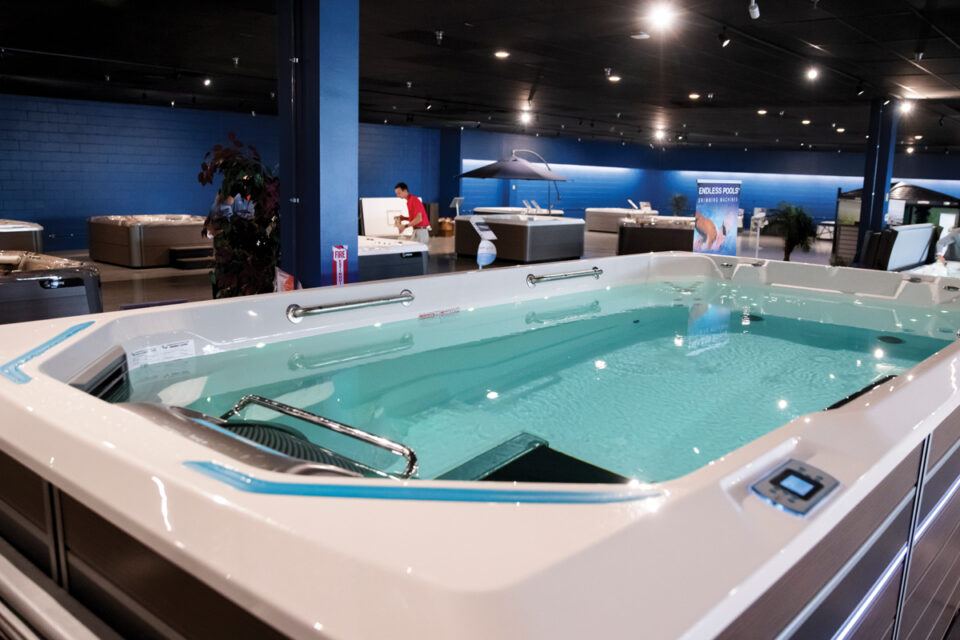
Safety considerations during a wet test
For potential buyers, a wet test is the best way to decide on a hot tub purchase, giving them a “try before you buy” experience. For retailers, it’s a marketing tool that can tip the scales toward a decision. But, in addition to preparation and cleanup, these tests also add another set of potential safety issues.
Matula says The Hot Tub Store fills select tubs similar to other models on the floor, which may or may not be the exact one the customer has in mind. In addition, he says, “We’ve been focusing on a two-minute hand soak, where people get their arm in the water and feel what warm water immersion does.”
He acknowledges that there are a few customers who just have to try it. In these cases, the company requires a signed waiver. This is an important step, says Jeannette Blanton, managing director for Higginbotham, an insurance agency headquartered in Fort Worth, Texas. “Retailers should at least have coverage [for a wet test] under their general liability policy, but depending on how the waiver is worded, they may need to have their attorney review it so it holds up in court.”
Retailers should have at least have coverage [for a wet test] under their liability policy.” Jeannette Blanton, Higginbotham
In addition to the waiver, which has customers’ contact information for follow-up, Matula goes a step further. He provides a quote and requires a customer’s credit card for a $500 deposit. This says, in effect, that they intend to buy something from The Hot Tub Store but they’re not sure which model yet.
Clark’s company continues to offer test soaks, but they usually try to pull back the reins at the request (or when consumers show up wearing their bathing suits and carrying towels) and get deeper into the conversation before making it happen. If you ask a few strategic questions, you can usually weed through those to see who are serious — or who just have a backache, he says.
“We’re in the business of selling stuff, and some folks really struggle to make a decision,” Clark says. “If everyone else in town is offering the tests and you’ve got salespeople who want to sell, customers will buy from the last one they wet test.”
For Townley, wet tests are something they offered in the past but are not often taken advantage of anymore. “I think COVID has gotten people worried about getting into tubs with water in them,” he explains. “For the past two years, we have not had a wet spa on the floor.” He says it has actually given them “some reprieve because now if the hot tubs are empty, they can sit in them, everyone can sit in them, and they can sit in more than one.”
For spa retailers, safety is an essential cost of doing business.
“It is an ongoing and ever-evolving thing,” Clark says. “The biggest takeaway is you just need to keep chipping away at it and then revisiting it on a regular schedule.”
[Safety] is an ongoing and ever-evolving thing.” Scott Clark, The Spa & Sauna Co.