Hidden Revenue
Where smart spa retailers are finding their next dollar

Rising costs. Tightening margins. Quieter showrooms.
Retailers’ instincts may tell them to chase more customers, but examining business operations can reveal a more immediate opportunity: increasing revenue from existing customers.
Hidden revenue isn’t about new products or more traffic — it’s about capturing more value from the interactions, services and relationships retailers already have.
From service calls and water care to accessories and valet programs, overlooked revenue streams are quietly shaping the industry’s top performers.
Sometimes the real opportunity is already inside the business.”
Crystal Lengua, Cover Valet
“Sometimes the real opportunity is already inside the business,” says Crystal Lengua, Cover Valet’s vice president of Canadian operations.
Too often, retailers assume revenue growth must come from more traffic, ad spend or leads, Lengua says.
“It is in the customer you already sold, the lead you already generated, the service call you already booked, the accessory conversation you almost had and the ownership pain point nobody turned into a solution,” she says. “That is what hidden revenue really is.”
As it turns out, the question isn’t where to find more revenue; it’s how much is already being left on the table. Much of it comes from areas retailers interact with every day but rarely treat as revenue drivers.
Common autopilot revenue drains
In many spa retail operations, some of the most profitable revenue streams quietly fall into “autopilot” mode, particularly water care, accessories, follow-up and service interactions.
These areas are often treated as routine transactions rather than strategic touchpoints, leading to missed opportunities for repeat sales and higher ticket averages.
While these categories may feel “routine” and “operational,” Lengua says, they are among the most consistent and margin-friendly areas when managed strategically.
Hesitation from staff, especially around making helpful recommendations, can further limit revenue potential. Without training and best practices, retailers may underperform in areas that should easily offer repeat business.
The issue isn’t demand; it’s a lack of systems to capture more value from each customer over time, Lengua explains.
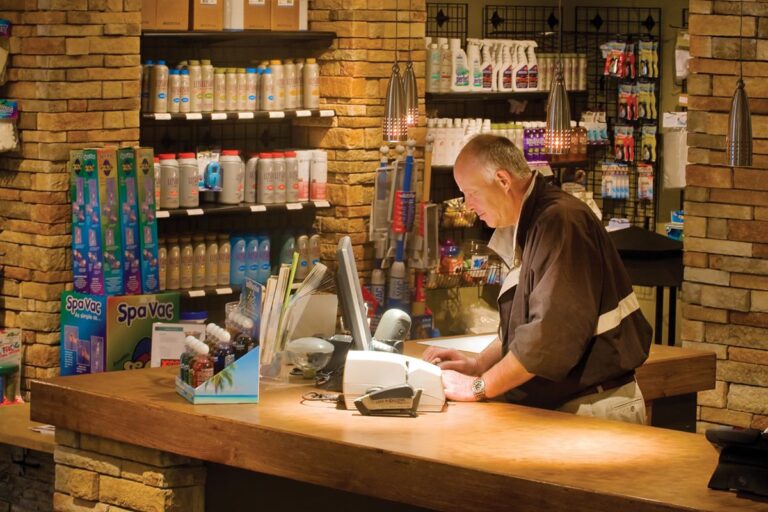
Water care is a prime example. A dedicated water-testing area in the showroom engages customers, creating repeat visits and consistent product sales.
“Water care gives retailers repeat touchpoints, educational opportunities and a reason to stay relevant in the customer’s ownership journey,” Lengua says. “If you are not actively building a system around water care replenishment, guidance and return visits, you are likely underperforming in an area that should be far more dependable.”
Consider the value of add-ons early
While water care builds long-term consistency, accessories offer one of the fastest ways to increase revenue at the point of sale. Retailers focused only on closing the spa sale are missing add-ons that increase total ticket value.
Rob Anderson, vice president of Olympic Hot Tub, has seen firsthand how add-ons — not just base units — drive profitability. The obvious ones are steps, lifters and water care systems, he says.
“In terms of the showroom, it’s all about the aftermarket add-ons,” he says. “It’s easy to overlook the value of any accessory that can be added to a hot tub.”
These additions don’t just enhance the customer’s experience; they are often higher-margin sales that immediately increase average ticket value.
“All of these other things can add up and can add back much-needed margin, which I think is what we’re all really after these days — how can we maintain margins when there’s increasing costs on everything?” he says. “For us, it’s all the add-on things that we do in the showrooms that really move the needle on average sales price on each ticket.”
Upsell without the pressure
The key to increasing accessory sales isn’t pushing more products; it’s reframing how they’re introduced.
During the sales process, walking customers through the showroom to see products that support daily use can help make accessory upsells more natural. A customer has arthritis? A cover lifter will support easy operation, while steps offer access and safety.
But waiting until the end to introduce accessories is when customers may feel “financially defensive,” Lengua says.
“When you anchor the conversation in ease, convenience, safety and longevity, it feels consultative rather than transactional,” she says.
For Norm Coburn, owner of New England Spas in Natick, Massachusetts, maximizing revenue starts at the counter.
“I think sometimes employees feel shy about selling,” he says. “We [as retailers] should try to [train] them that it’s OK to make suggestions that the customer will find helpful, rather than us coming across as pushy.”
Coburn’s team begins each interaction by pulling up customer history, allowing staff to identify patterns — when filters were last replaced, what products customers typically use and where there may be gaps. That shift from transaction to consultation has helped increase average ticket value organically while improving the customer experience.
The guiding question: How can the customer’s daily hot tub use be made easier, safer or more enjoyable?
When the answer is clear, the sale often follows.
Framing it as “This will make your spa easier to use, easier to maintain or more enjoyable long term” will win customers over more easily, Lengua says.
Are You Monetizing Valet and Delivery Services?
Operational changes to increase hidden revenue streams
While showroom strategies play a key role, some of the biggest gains come from operational shifts, particularly in the service department.
“Too many retailers still view service as a support function when it should be treated as a strategic revenue channel,” Lengua says.
Service teams, she explains, are uniquely positioned to identify future revenue opportunities — spotting aging components, recurring maintenance challenges and upgrade potential long before sales staff can.
That can include recommending replacements, suggesting upgrades or introducing service plans before issues become urgent.
Recurring service plans, sometimes called valet service, in particular, can turn one-time service visits into predictable revenue. Instead of relying on one-off calls, retailers can build steady income while consistently engaging with customers.
“Hidden revenue tends to increase when retailers get better at connecting the business internally,” Lengua says.
Anderson agrees.
Everyone wants to do a lot in service, but they don’t necessarily run it as its own business.”
Rob Anderson, Olympic Hot Tub
“Everyone wants to do a lot in service, but they don’t necessarily run it as its own business,” he says.
At Olympic Hot Tub, service operates with its own P&L, creating clear visibility into revenue, costs and profitability.
While that structure requires effort, it allows service to be managed with the same discipline as retail by tracking performance, controlling costs and identifying growth opportunities.
“It takes marketing, structure for the teams and a lot of managing parts and inventory like you would with showroom products,” Anderson says.
Refurbished tubs as a moneymaker
Refurbished hot tubs can be a strong revenue stream, but only with clear processes and consistent standards.
As Anderson notes, there is a “definite market for preowned spas,” with some units even able to “rival, if not exceed,” the margins of new models when sourced and priced correctly.
At Olympic Hot Tub, that success is driven by structured processes, from trade-in evaluations to refurbishment standards and warranty backing. That ensures that the spa is “working 100%,” Anderson says.
Lengua echoes that the category can either be a high-margin acquisition tool or an operational drain, depending on execution. When managed well, refurbished spas not only monetize trade-ins but also create accessible entry points, drive upgrade cycles and keep more customers in a retailer’s ecosystem.
“A strong trade-in culture helps retailers unlock customers who might not have upgraded otherwise,” she says.
Make the numbers visible
For Olympic Hot Tub, sharing performance metrics with team members — service, valet, delivery — has incentivized them to work harder to improve sales.
“They knew how much money they were bringing in as a department but didn’t know what the bottom line looked like,” Anderson says.
Sharing revenue, cost of goods, gross profit and expenses gives teams a clearer understanding of how their actions impact the business.
“They really appreciate knowing what that is and knowing that they can and do have an impact on it,” Anderson says.
Coburn’s team builds accountability through consistent communication at monthly team meetings, where peer-driven learning includes shared performance metrics. Top performers share what’s working, helping raise the collective standard.
That visibility helps employees understand how their actions directly impact revenue. As Lengua emphasizes: “What gets measured gets noticed. Data is still king.”
Find the opportunity that already exists
Many retailers have an overlooked profit center they can focus on immediately that can generate revenue.
Reengaging prior leads, service customers, inactive owners and lapsed chemical buyers can unlock immediate opportunities. These customers already know your brand and many still need water care, accessories, service or upgrades.
“The acquisition cost has already happened,” Lengua says. “The relationship already exists. The awareness is already there. In most cases, the issue is not whether the opportunity exists. It is whether the retailer has built a system to go after it consistently.”
In many cases, the next dollar isn’t coming from a new customer — it’s coming from better systems, better follow-up and opportunities that are happening every day.