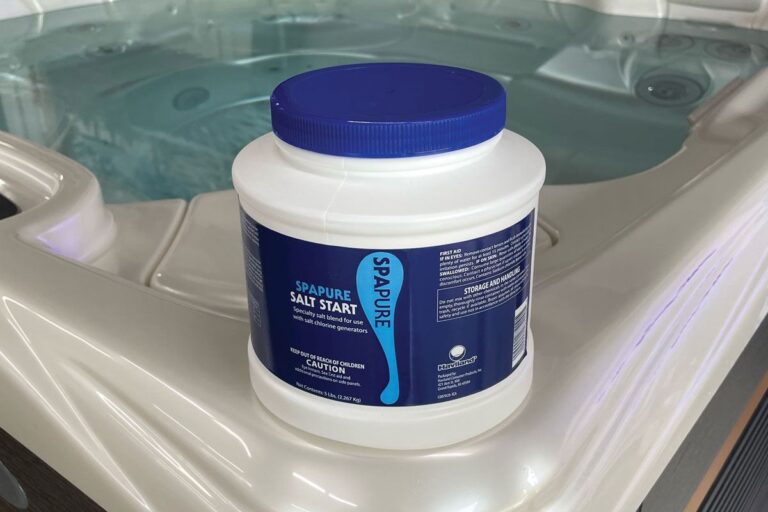
Let’s Talk Chemicals
Leading conversations with customers without losing them in terminology

Words like “oxidation,” “alkalinity” and “pH” may leave some customers running for the door. For those tuning out when it comes to buying chemicals, try toning down the jargon.
“For me, it’s all about referring back to something in everyday life that everybody is familiar with,” says Alicia Stephens, director of training and education for Lawrenceville, Georgia-based BioLab, Inc. “[Customers] don’t have to know about electrons or oxidation numbers. They need to understand what you need to do to a [spa], and you have to be able to put that in terms that they can relate to.”
Use customer-facing language
Take, for instance, a conversation where a salesperson tells a customer that a sanitizer has a 99% disinfection rate and requires a 25-second contact time — that’s a surefire way to make them tune out, Stephens says. Instead, she encourages sales staff to teach customers to care about three things:
- How will it save time?
- How will it save money?
- How does it create a better experience?
Using analogies and customer-facing language, the conversation goes from mundane to miraculous — clearly showing how the product solves problems and keeps their spa sparkling.
“If you change the language to, ‘This product is strong. It’s going to keep your [spa] safe, it’s going to last longer and your water is going to be super clear,’ it’s the same product, but a whole different conversation,” Stephens says. “Because you relate it to things that the customer cares about.”
Listen to customers’ needs
To build customer loyalty and trust in your products, start by listening to what they need.
“The whole point of selling is to listen and to find out what that customer wants, what they need, what their lifestyle is and what their priorities are, and then speak intelligently about solutions for those needs,” says Elise McHugh customer care coordinator for the service division at Patio Pleasures Pools & Spas in Wisconsin.
Consider this scenario: An Airbnb property with a hot tub may require a slow-release self-dispensing sanitizing system because the opportunity to check the chemical balance is infrequent and maintenance may be conducted by a housekeeper once a week. Meanwhile, a hot tub owner who is prone to skin reactions may benefit from a nonchlorine sanitizer system, McHugh points out.
It’s less about the chemicals and more about showing customers that you are there for them every step of the way.”
Elise McHugh, Patio Pleasures
“It’s less about the chemicals and more about showing customers that you are there for them every step of the way, that they are never an inconvenience and their questions are never stupid,” McHugh says. “They’ll not only be much happier with their purchase and your company as a whole, but anytime they need something, you’re the people they’re coming back to.”
Tell your story
Particularly for first-time hot tub owners, Stephens says the best way to make them believers in your chemical products is to set the tone for what they need.
When BioLab introduced rapid-dissolve tabs, dealers noted they weren’t selling very well because they were more expensive than traditional methods. However, when Stephens encouraged salespeople to try them with new hot tub owners, they were a hit because there was no measuring required — a perk for those who don’t want to be bothered with learning about water balance or chemistry.
“Whatever you send them out the door with becomes their normal,” Stephens says. “If you want to create that normal with a particular program, a kit or whatever it is that you’re highlighting in your business, get them attached to what you’re selling, and that’s when you get a loyal customer. Each dealer has a different norm as far as what their programs are, and you’ve got to tell your story.”
Know your water
In some cases, conversations don’t have to be about chemicals at all. One spot where sales staff can hedge their bets is knowing about the water quality in their area, McHugh says.
“The biggest thing is getting a good handle on the sort of water that you have in your region and understanding what its particular quirks are,” McHugh says.
In southern Wisconsin, for instance, water has a high alkalinity, so knowing how to treat it from the onset establishes a good rapport with customers.
“Getting that water dialed in will leave fewer opportunities for massive problems down the road,” McHugh says. “And it helps to address about 75% of the issues that come through the door.” She adds that one of the most important things salespeople can do is understand the ideal alkalinity and pH ranges for the sanitizers they sell.
Have a reliable network
When all else fails, McHugh recommends a chemical guru at your manufacturer for backup.
“You need to have somebody in your back pocket who is a chemical wizard, who you can go to at any point and they’re going to have an answer for you that’s going to work,” McHugh says.
For trickier problems, she says the relationship between the manufacturer and retailer will save the day.
“Most of us are where we are today because we have connections with our manufacturers,” McHugh says. “And that’s a critical thing for companies to have if they’re struggling to get that chemical literacy to inspire confidence in their customers.”