From Walk-in to Warm Lead
Capturing in-store leads without being intrusive
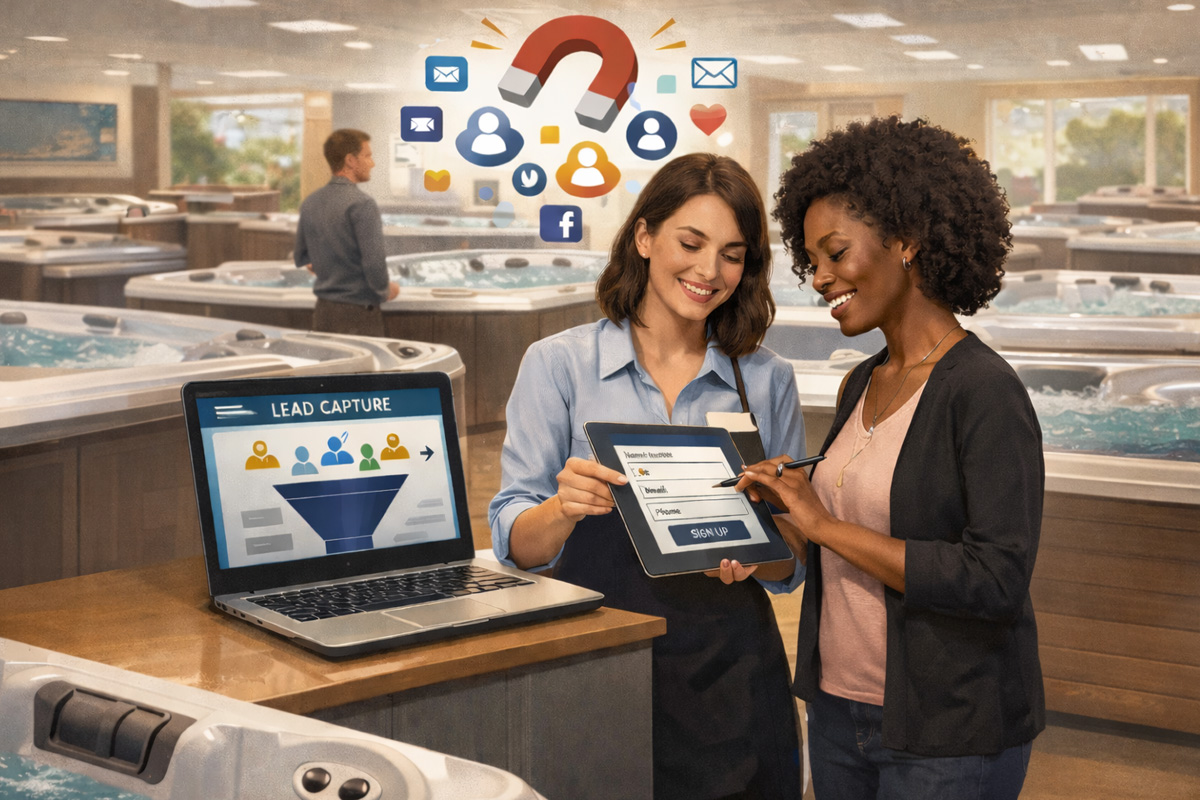
You likely already know two key things about customers who walk into your showroom: They’ve researched spas online, and they’re ready to see, feel and maybe even test one in person. That level of buy-in gives your team an opportunity to close sales today and build a pipeline for tomorrow.
The challenge is moving beyond that surface-level interaction without disrupting the shopping experience or feeling intrusive. Successful retailers gather useful information through natural touchpoints, from the first conversation to showroom signage, interactive tools and demonstrations.
But whether the interaction happens in person or through technology, it should feel like helping customers where they are in the moment. “I’m giving you [something of value] and providing a service, without making it feel transactional,” says Nadine Nuzzo, retail division manager for Arvidson Pools & Spas in Illinois.
That service mindset starts the moment they walk in.
The first touch
At Arvidson, the first step is simple. “We ask, ‘What made you decide to get a hot tub?’ so we can narrow down their focus,” Nuzzo says.
That initial exchange includes introductions and gathering a first name, but the emphasis stays on discovery and building familiarity.
“The more comfortable the customer gets, the more you know about them, the more you can connect with them and the more likely they are to share their information,” Nuzzo says.
Ask the right questions
That discovery naturally leads to gathering useful information. Determining the “why” behind a customer’s interest (relaxation, entertainment, health benefits) and the timing (today or in the near future) can help shape the sale naturally. It’s also important to understand where the spa will fit in their backyard.
Contact information can be gathered by asking, “Would you like a quote?” Or, “I’m not sure about that. Let me double-check for you. What email can I send this to?”
Steve Jost, sales and marketing manager for Dover Pools in Dover, Delaware, says many opportunities arise when customers ask for printed materials that no longer exist. “Everyone’s going green; everything’s digital,” he tells the customer. “But let me get your information, and I’ll send you a copy of the online brochure.”
Rather than requiring a form up front, he prefers to make the exchange feel purposeful. “We would just try to get it organically by having it come up in the conversation [so there is] a reason why we’re capturing information,” Jost says.
If customers have done business with the store before, that’s another natural entry point. “Oh, let me make sure we got your information updated in our computer system,” Jost recommends asking.
Often, that reveals outdated phone numbers or email addresses, letting the team refresh contact details without making it feel like a cold request. Even a routine supply purchase can create the same opportunity.
Let the showroom sell
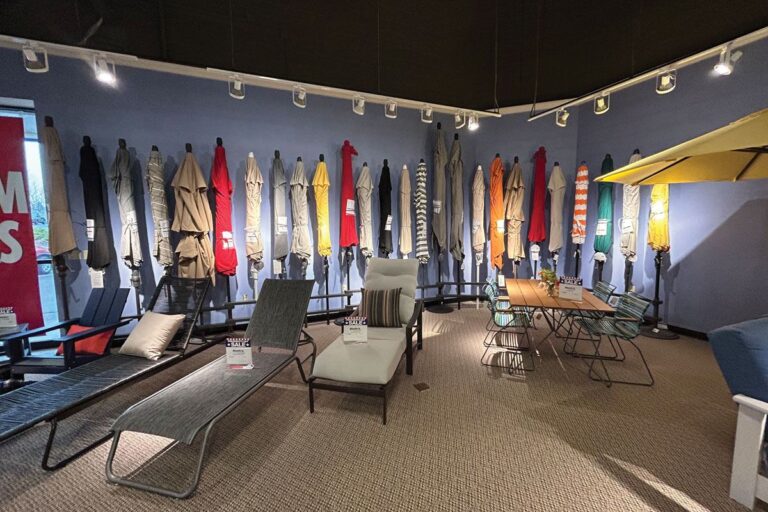
Lead capture doesn’t stop with conversation. Physical merchandising, which has evolved to include more interactive technology, also plays a role.
For instance, QR codes placed on hot tubs can entice customers to view product data sheets or tutorials, with a prompt to send that information via email. Digital signage can also spark questions and keep customers engaged while they browse.
Interactive digital tools take it one step further. Some retailers install kiosks displaying touch screen videos with product demonstrations, model comparisons and special features, requiring an email address to send the results.
Other retailers, like Nuzzo, prefer a more personal approach. “Arvidson is a destination store,” she says. “Someone who walks through our door has already decided to buy a hot tub. They’re just trying to figure out where to buy it from. So making that [personal] connection gets them in a more comfortable space.”
Dover recently started using large iPads to show customers more options or different colors, Jost says. These digital tools prove especially useful when discussions turn to backyard space and logistics. Sales teams can display customer locations on Google Earth to show where their hot tub will fit, he says.
The next step, Jost and Nuzzo agree: “Would you like me to send you a quote? Where should I send it?”
Nuzzo says they leave the choice of contact method up to customers, who may prefer a text rather than an email. Other retailers add digital touchpoints, such as offering free Wi-Fi that requires contact information to access.
The power of the wet test
You can’t get more experiential than offering a wet test. These allow customers to experience the comfort, jet action and seating in a tub they’re considering, and the informality invites valuable information sharing, from contact details to purchase timeline and feature preferences.
It’s unlikely customers brought swimsuits with them, Jost says, but they’re often open to scheduling an appointment via email for a future soak. “Only about 20% of our customers take us up on it,” Nuzzo says.
Even scheduling the test creates actionable follow-up opportunities, both before and after the soak.
On the way out
As customers exit your showroom, a simple check-in can take the form of:
“I noticed you were looking at [specific model]. Would you like me to check availability?”
“Do you have any questions about [specific product]?”
“Would you like us to let you know if this model goes on promotion?”
“Would you like to receive our newsletter? We’re planning to feature …”
Balancing lead capture with customer experience takes intention. When sales staff focus on value and service, customers leave feeling supported, not reduced to a data point.