Alice Cunningham
Building a company, a culture and a category
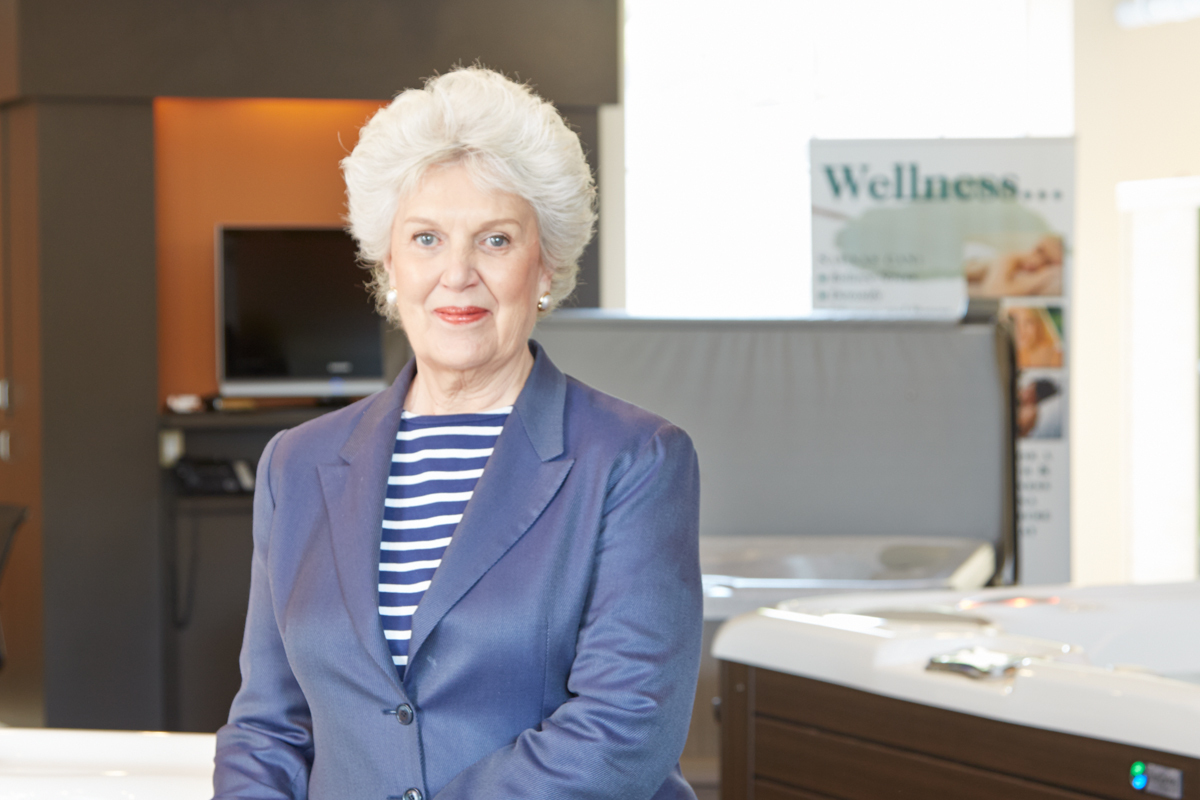
When Alice Cunningham walked away from a prestigious federal career in the mid-1970s to start a hot tub business, her father cried.
She had a month of vacation, excellent benefits and a senior role administering job training programs for tens of thousands of people nationwide. She was, by every conventional measure, doing exactly what she was supposed to do.
And then she met Blair Osborn.
After talking deep into the night, Cunningham and the University of Washington professor made three decisions: they would leave their bureaucracies, build something together and never be apart.
Within a year, they were opening the doors to what would become Olympic Hot Tub, a company that would help define modern spa retailing and leave a lasting mark on the hot tub industry.
Selling a product no one understood
In the ’70s, hot tubs were more of a curiosity than an industry.
When Cunningham and Osborn opened their first store on the shores of Seattle’s Lake Union, they put a wooden tub in the window, attracting plenty of questions from passersby. “You put it outside,” Cunningham would explain, “and you go bathing in it.”
People thought they were nuts.
But from the beginning, Olympic let customers soak. If people found the store, no small feat in the pre-Google Maps era, they could try the product. Early adopters became evangelists, friends followed friends and one sale led to another.

A pivotal industry moment
Olympic’s trajectory — and arguably the modern spa industry — shifted in the early 1980s when Cunningham and Osborn connected with Watkins Manufacturing, now Watkins Wellness.
At the time, the market was pivoting toward plastics, but many early products failed under heat stress. Osborn, whose doctoral work focused on heat and plastics, knew the risks.
When Watkins sales executive O.T. Neal insisted they see the product in person, Cunningham was skeptical.
“You must be from California,” she told him. “Hyperbole is your middle name.”
When they arrived in Escondido, they found an open-air shed, tubs on dollies and two engineer brothers methodically building something different.
At the end of the visit, Osborn delivered what Cunningham describes as the highest possible praise from an engineer: “There’s nothing wrong with it.”
Olympic became one of the earliest Hot Spring dealers and one of the most influential. Within minutes of opening the Seattle store after the Watkins visit, they sold their first portable spa to a woman who believed it would encourage her grandchildren visit more often.
“She said, ‘You’ve been in business a long time. I’ll take one,’ ” Cunningham recalls. “I didn’t even know how much to charge her.”
Marketing before the industry had language for it
Long before “content marketing” existed, Cunningham was doing it.
She published a quarterly newsletter about hot tub life — what to wear, what not to eat, etiquette, health benefits and family time. Customers called when issues were late, and even mailed back postcards voting on one question that became legendary: Nude or not nude? It generated poems, jokes, newspaper coverage and foot traffic.
Rejecting traditional marketing tropes, Cunningham focused on family, health and wellness, years before “wellness” became a buzzword.
Her instincts extended early into digital territory. Olympic launched its first website in 1994, two years before Hot Spring established a web presence. Over time, Cunningham built a blog that exceeded 800 posts, treating the website as an extension of the showroom rather than a static brochure.

Beyond the showroom
By the early 2000s, Olympic had become one of the top-performing Hot Spring dealers in North America, earning the manufacturer’s highest sales honors multiple times.
In 2016, Cunningham and Osborn were inducted into the Hot Spring Ring of Honor, recognizing their long-term impact on the brand and its dealer network. That recognition later became institutionalized when Watkins Wellness established the Alice Cunningham Marketing & Promotions Award, presented to dealers who demonstrate creativity and leadership in retail marketing.
Olympic also received honors including SBA’s Best Business in the Northwest and Arthur Andersen’s Best Customer Service Award — accolades rarely awarded to regional specialty retailers.
Building people, not just stores
Cunningham and Osborn grew Olympic to five locations across Washington state (it currently has eight), but Cunningham measures success differently.
“I look at all the people we employed and the lives they built,” she says.
Olympic became a training ground for many of the industry’s most respected leaders. Employees bought homes, built careers and stayed for decades. The company valued transparency, sharing financials openly and holding regular staff meetings.
In a 2014 SpaRetailer profile, current owner Don Riling — then a senior leader at Olympic — reflected on the environment Cunningham and Osborn created.
“Without sounding schmaltzy, Alice and Blair are really stars in my book, because they have given us a place to work that’s unique,” Riling said. “I think it’s easy for employees to lose sight of that sometimes, but when you step back and look at it, it makes you want to be better.”

Integrity as a business strategy
Olympic built its reputation on service and restraint. If a customer set off alarm bells, Cunningham would walk away from the sale, which saved the company from costly legal trouble more than once.
“We had a very low threshold for embarrassment,” Cunningham says. “We didn’t want to hide behind a pillar if we saw a customer in public.”
That philosophy extended to utilities fights, recession survival and customer advocacy. During a proposed electricity crackdown in Tacoma, Olympic’s customers showed up en masse to defend their right to soak, and the city backed down.
At one point, Olympic sold enough units in the Puget Sound area to provide more than 50,000 hot tub seats ready for soaking every night of the year, according to a 2003 Seattle Times article — a number comparable to the seating capacity of Seattle’s Husky Stadium.
Bigger than one company
Although Riling officially took over in 2016, Cunningham’s influence can still be felt.
Each year, Olympic hosts a Founder’s Event, raising funds for local nonprofits like Food Lifeline, Behind the Badge and Artist Trust. “Alice and Blair were passionate about a number of worthwhile causes,” Riling said when the event was launched. “Our company has always been focused on health and wellness — not just physical, but the health of spirit and creativity.”