AI in Business: Smarter, Faster and Still Human
How spa retailers are using AI to improve efficiency, strengthen customer service and drive growth without sacrificing the personal touch

The spa business has always been a people business.
From the first showroom visit to the final installation, success is built on relationships, trust and expertise. Customers don’t just buy a hot tub, swim spa or sauna — they invest in a lifestyle, and they want confidence they’re making the right decision. That confidence often comes from a knowledgeable salesperson, a trusted service technician or a retailer who answers their questions and guides them through the buying process.
While the foundation of the industry remains unchanged, the way consumers shop has evolved dramatically.
Now, customers research products online, compare reviews after dinner, submit inquiries late at night and expect answers almost immediately. Retailers are challenged to deliver the same personalized experience they’ve always provided while keeping pace with an increasingly digital marketplace.
That shift has sparked growing interest in artificial intelligence.
Jake Ricks, vice president of marketing and customer experience at Bullfrog Spas is among the industry leaders already incorporating AI into his duties. “AI is critical to my work,” Ricks says. “It’s speeding up everything from writing to analysis to strategic planning.”
Beyond his responsibilities, Ricks says Bullfrog is using AI across marketing and customer-facing departments to improve efficiency.
It’s not a magic bullet … The risks need to be well-understood, but it is certainly going to be a big part of the future.”
Jake Ricks, Bullfrog Spas
“It’s not a magic bullet, though, and the risks need to be well-understood, but it is certainly going to be a big part of the future of work,” he says.
Those risks can include inaccurate information, poor customer experiences and content that feels generic or inauthentic.
The question for spa retailers is no longer whether AI can help their business; instead, it’s where AI belongs, where it delivers real value and where the human element should remain firmly in place.
Winning the race to respond
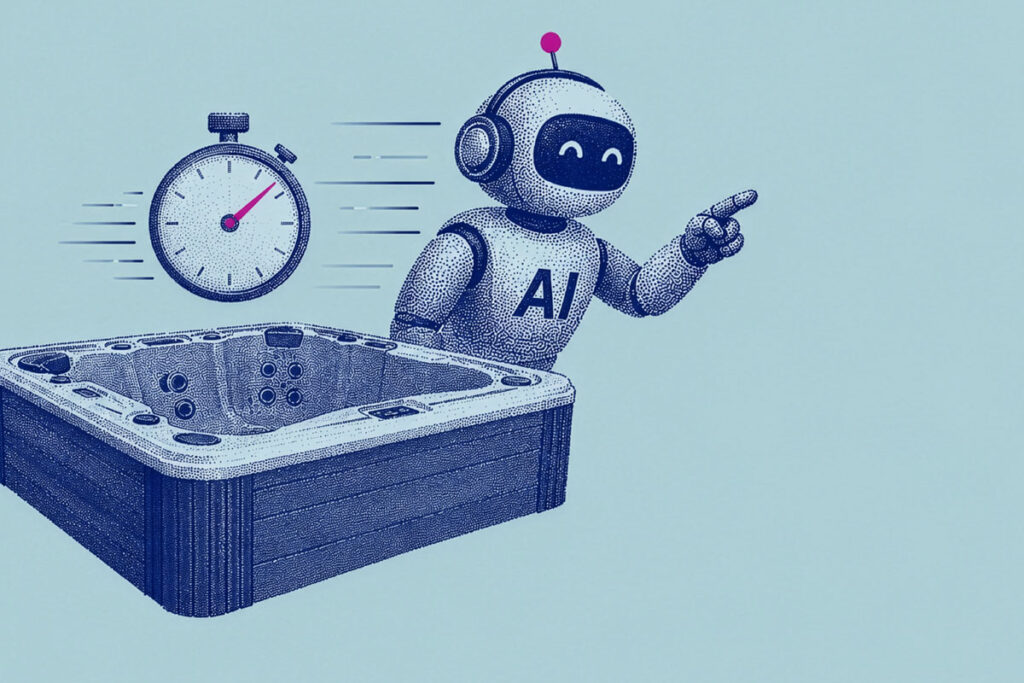
One of the most practical uses for AI is helping retailers respond to customers faster.
Shoppers expect businesses to be available when they’re ready to engage, not necessarily when the showroom is open.
“As consumers, we’re trained by Amazon to want something now, and we want to be able to purchase stuff on our timetable, not on another business’s timetable,” says Lance Walbecq, founder of Sauna Spa AI, an AI automation company that helps spa, sauna and wellness businesses improve customer communication, capture leads and streamline operations.
For that reason, Walbecq believes AI’s greatest value is helping retailers make sure no opportunity goes unnoticed. AI can provide a system that helps retailers capture opportunities instead of letting them slip through the cracks. “Let’s never miss a phone call. Let’s never miss somebody that hits your website,” he says.
Tyler Pelletier, co-founder of SpaSurge, a digital marketing agency focused on helping spa and backyard leisure retailers, agrees. “When a lead comes in, we tell everybody you want to contact that lead within five minutes,” Pelletier says. “The first person to reach the lead has a much higher chance of turning that lead into a sale.”
AI-powered text messaging, chat tools, call scheduling and voice assistants can help acknowledge inquiries, answer basic questions and schedule appointments while employees are unavailable. For retailers competing in crowded markets, those seemingly small interactions can create a significant advantage.
“You can adopt this AI technology and use it to your advantage early and get ahead of everybody, or you can continue chasing the opportunities,” Walbecq says.
Augment, don’t replace
While AI excels at speed and efficiency, all three experts caution against expecting it to replace people.
One of the most common misconceptions surrounding AI is that it can automate the entire customer experience.
Pelletier has spent years testing AI voice technology and said the tools still have limitations.
“There are awkward pauses. Weird social cues. It doesn’t understand interruptions,” he says.
Although voice assistants are improving, Pelletier believes retailers should view AI as a supplement to human interaction, not a substitute. “If you try to replace a human sales rep with AI, you’re probably going to have some issues,” he says. “You want to use AI alongside a human.”
Walbecq, who helps build AI voice assistants, agrees that the technology isn’t perfect, but expects it to become increasingly natural over time. He believes some engagement is better than none when retailers aren’t immediately available.
“Would I rather, as a consumer, feel some form of engagement than zero engagement? Yes, I would,” he says.
People still want to deal with people. AI can help the business owner build a better net. Then you have the ability to [have] that human interaction.”
Lance Walbecq, Sauna Spa AI
For many retailers, AI’s greatest value is not replacing human interaction, but ensuring potential customers receive an immediate response rather than being sent to voicemail.
“People still want to deal with people,” Walbecq says. “AI can help the business owner build a better net. Then you have the ability to [have] that human interaction.”
Best uses may be behind the scenes
Retailers are increasingly using AI to draft emails, summarize meetings, create action items, organize information and analyze customer interactions.
Pelletier points to AI-powered sales analytics as one of the most practical applications. “It’ll listen to all the phone calls and grade the conversation from A to F with notes on what [sales reps] could improve on next time,” he says.
For retailers managing multiple salespeople or locations, that type of coaching can provide valuable insights without requiring managers to listen to every call.
AI can also act as a training resource. Pelletier, who previously owned his own spa dealership, recalls spending hours studying sales books and training programs to help respond to customers. “If I was dealing with a sales objection consistently that I couldn’t overcome, I’d read Zig Ziglar books or go back through Jordan Belfort training,” he said. “Today, salespeople can simply ask AI how those experts might respond to a specific objection, and you get an answer in five minutes,” Pelletier says.
Ricks has also seen businesses use emerging AI coding tools to create simple internal applications and websites and automate processes that previously required expensive outside resources and technical expertise.
“I’ve seen people build some really cool simple apps using Anthropic’s Claude Code tools to basically replicate business systems that previously would have been cost prohibitive,” Ricks says. “Need an inventory system, a service scheduling system or a simple CRM? You can build it yourself with a Claude Code subscription.”
Marketing: Powerful, but proceed carefully
Marketing is often the first place retailers experiment with AI, and it can be one of the most productive applications when used correctly.
AI can generate social media posts, email campaigns, blog articles, advertising concepts and website copy in seconds. The challenge is ensuring the content still sounds authentic and reflects the brand.
“If you just throw in, ‘Write me a sales email,’ it’s not going to put out anything good that’s going to generate results,” Pelletier says.
The quality of AI output is heavily influenced by the quality of the instructions it receives. “The key to successful AI content creation is using the proper prompts,” he adds. “Prompting is everything.”
Ricks has observed similar results. “I’ve seen businesses use AI tools to create ads more quickly and efficiently,” he says. “But you do have to be careful so they look and sound real.”
That caution is important because poorly executed AI content can damage credibility. “A bad AI ad can be worse than a bad traditional ad,” Ricks says.
Consumers may not always recognize AI-generated content, but they often recognize content that feels generic, repetitive or disconnected from the brand. Still, neither believes retailers should avoid AI altogether.
“If you’re careful, it can really augment your creative capabilities and productivity,” Ricks says.
The most effective marketers are using AI as a creative assistant, not a creative director. Technology can assist strategy, but it cannot replace it.
In the end, the retailers who thrive won’t be the ones that automate every interaction. They’ll be the ones that embrace AI thoughtfully to respond faster, operate more efficiently and free up time for the human connections and interactions that matter most.